Reading a Public Consultation Without Mistaking It for a Vote
A public consultation reading checklist helps you spot what is open to influence, how to submit a useful response, and what the authority must explain afterward.
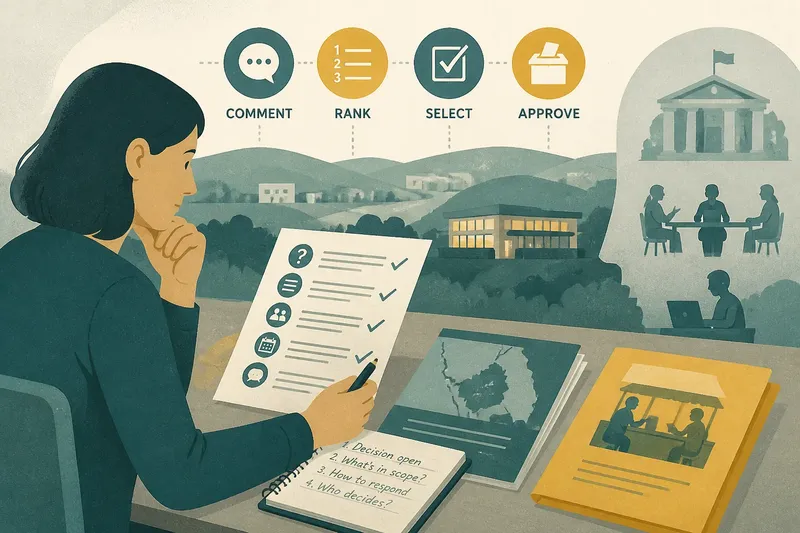
A public consultation reading checklist can help you tell whether an authority is asking for a view, a ranking, or a choice among options. That distinction matters when a regional council invites comments on a proposed change but has not asked residents to approve or reject it.
What decision is still open?
Start with the sentence that describes the decision. Find it in the consultation notice, the first page of the survey, or the summary of the proposal. Identify the object of comment: a draft policy, a service change, a set of options, or a problem the authority is still examining.
Then separate the main decision from the survey prompts. A form might ask whether you support a broad goal and then ask how it should be delivered. Those are different judgments. You can support the goal while objecting to a particular measure.
Notice the verbs. “Comment on” invites a view; “rank” asks you to order options; “select” asks you to choose; “approve” may imply a different process altogether. If the wording is unclear, state how you have interpreted the question before giving your response.
Write down the decision in one sentence. That sentence will help you keep your comments focused.
Which parts of the process can residents influence?
Consultations often ask about some parts of a proposal while treating others as settled. The boundary may appear in phrases such as “the proposal covers,” “the consultation concerns,” or “decisions already made.” Compare that language with the survey questions and supporting papers.
A consultation about the location of a service may not reopen whether the service will continue. A review of opening hours may not include staffing or eligibility rules. You can still raise a connected concern, but identify it as a separate point rather than implying it is one of the choices on offer.
Boundaries may also reflect geography, legal duties, timing, funding decisions, or another agency’s responsibilities. If a regional body is asking about its own arrangements, it may not control a neighboring agency’s policy. Ask the consultation contact whether comments beyond the stated scope will be recorded, passed on, or excluded.
Say you receive an invented consultation about keeping one of two regional service counters open later. The notice asks only about evening hours, while your starting view is that both counters should remain open and that evening appointments would help. First, answer which counter should have later hours and explain why. Next, state that keeping both counters and adding appointments are related requests, not options listed in the notice. The resulting response makes your position clear without suggesting the authority promised to decide those extra questions.
How can you tell whether your response will count?
Check the invitation for eligible participants and accepted submission routes. An online form, email address, written submission, public meeting, or local office may each serve a different role. Do not assume that speaking at an event counts as a formal response unless the notice says so.
Before choosing a route, check for fixed questions, character limits, file rules, and a closing date. If you need another format, language support, or help accessing the form, contact the consultation team early and ask what it can accept. If you are submitting for a residents’ association or another group, say whether the response reflects an agreed position or your own view.
Use this submission check before sending:
- If the notice names a specific audience, check that your response fits it; if it does not, ask whether other responses are accepted before drafting.
- If the notice lists accepted routes, use one of them; if your preferred route is missing, contact the team and ask whether it will count.
- If the form has a character limit or required questions, check your draft against them; if it does not fit, shorten it or ask about an alternate format.
- If the closing date is clear, plan to submit before it; if it is missing or ambiguous, ask the consultation team to confirm the deadline.
- If you need accessible materials or language support, request them promptly; if the offered format does not work, ask what other arrangement is available.
- If you are writing for a group, check that the group has agreed to the wording; if it has not, identify the response as your personal view.
- If the submission system provides confirmation, save it with a copy of your response; if no confirmation appears, contact the team to check whether the response arrived.
Pick the route that lets you answer the stated questions clearly and leaves you with a record of what you sent.
Who collects the views, and who decides?
Look for the named consultation lead, department, council, committee, minister, or other public body. The team collecting responses may not be the body that makes the decision. A regional partnership, for instance, may gather comments for several agencies without having authority to settle each agency’s policy.
Check what the notice says will happen next. It may describe a response summary, a report to a committee, a revised proposal, or a later decision. Find out whether the responses will be published and how personal information will be handled before including sensitive details.
If responsibility is unclear, ask two direct questions: “Who makes the decision?” and “How will responses reach that decision-maker?” Those answers help you understand whether comments will be considered directly, summarized, or forwarded elsewhere.
Look for the named decision-maker before you spend time polishing a long submission.
How should you use the supporting documents?
Read the consultation notice first, then check the proposal, options paper, map, service description, or explanation of legal duties. A summary can orient you, but the supporting papers may define the proposed change more precisely.
As you read, make a short note on four points:
- Current arrangement: What happens now, and which body is responsible?
- Proposed change: What would be different for residents, staff, or organizations?
- Open options: Is the authority comparing alternatives, refining one proposal, or asking how to implement a settled direction?
- Stated limits: Which constraints or earlier decisions does the document treat as fixed?
Check that a map or chart covers the same place named in the consultation. A paper about a wider region may not describe the particular service under review. If a technical term is unclear, look for a glossary or ask the consultation contact for a plain-language explanation.
Use local knowledge to answer the question in front of you. If a proposed service location depends on a bus connection, explain where the connection matters and how it affects access rather than assuming the link is obvious.
What makes a response useful to a decision-maker?
Answer the actual prompt, explain your reason, and say what you want the authority to consider. Separate a factual correction from a preference, and distinguish support for a goal from support for every proposed method.
If you refer to a local condition, name the place or service clearly enough for officials to identify it. Attach only material that supports your point, and avoid including another person’s personal information without permission.
Before sending, check that your response identifies the question, the relevant boundary, the people or services affected, and your requested action. If one of those is missing, revise the draft before submission.
What questions should you settle before responding?
Does a consultation response count as a vote?
Usually, a consultation collects and considers views rather than holding a binding vote. Check the notice for an explicit decision rule; if it does not say responses determine the outcome, treat a survey choice as a comment, not a ballot.
Can I raise an issue outside the stated scope?
You can raise a connected concern, but label it as outside or adjacent to the decision described. Ask whether the authority will record, forward, or exclude such comments so you know how they may be handled.
Will I receive an individual reply?
Do not assume that every respondent will receive a personal answer. Check whether the notice promises a published summary or another form of reporting, and review its privacy information before sharing personal details.
What if the decision-maker is not named?
Contact the consultation team and ask which person or body will decide and how responses will reach it. If the answer remains unclear, state that you want your comments passed to the responsible body and keep a copy of your request.
What should you look for after submitting?
Keep the consultation title, your response, and any confirmation together. Later, check the authority’s website or contact the listed team for the response summary and decision notice. Compare that record with the question you answered: does it explain which views were considered and why the authority chose its course?
A decision that differs from your preference does not, by itself, show that your response was ignored. The authority may have weighed comments alongside its duties, service needs, and other stated constraints. If the published account leaves a specific point unanswered, ask a focused follow-up question.
Use the public consultation reading checklist to track what is open to influence, which route counts, and how the authority says it will report back. A clear record of those details gives you a sound basis for judging whether the process matched its own terms.