How Regional Cooperation Forums Are Designed to Work
Regional cooperation forums work best when members define their purpose, authority, and follow-up clearly, giving neighboring governments a usable way to coordinate.
Regional cooperation forums need more than a meeting date: members must decide what the forum can do, who speaks for each government, and how decisions return to public agencies. Those design choices shape whether a forum can handle shared work without blurring each participant’s authority.
What should a regional cooperation forum be responsible for?
Start by naming the work the forum exists to do. A forum might exchange information, make recommendations, coordinate a shared program, or oversee a task that members have assigned to it. These are different functions, and using a broad phrase such as “regional cooperation” does not settle which one applies.
Write the purpose in terms of an identifiable job. If members want to coordinate ferry schedules, for instance, specify whether they are sharing notices, aligning timetables, or deciding how a jointly funded service operates. The more consequential the job, the more carefully members should define authority and accountability.
A useful mandate also names what falls outside the forum’s remit. That boundary helps staff refer unrelated matters to the appropriate agency rather than treating every cross-border concern as a forum decision.
Who needs a seat at the table?
Representation should match the forum’s assigned work. Transport officials can address operating details, while elected leaders or ministers may need to settle priorities and approve commitments. Local governments, service providers, or community representatives may also need a route to contribute when their responsibilities or daily services are affected.
Members should decide who may speak, who may commit an agency, and who must seek approval at home before agreeing to an action. A participant who can share information may not have authority to change a budget, a regulation, or a service plan.
Keep a current contact list with each member’s role and decision authority. If a position changes, update the list before the next discussion.
How should a forum handle decisions and follow-up?
Set out how the forum reaches decisions before a disputed item arrives. Members might seek consensus, record differing positions, or make recommendations that each government considers through its own process. The appropriate arrangement depends on the mandate; it should not be left to assumption.
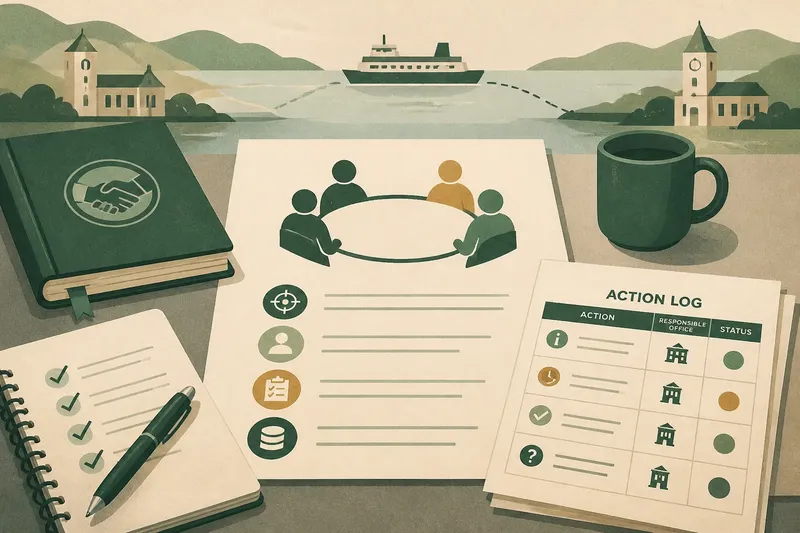
For each decision or recommendation, record the responsible office, the next action, and any approval still needed. Meeting notes should distinguish an agreed action from a proposal or an unresolved question. That simple distinction prevents a discussion from being mistaken for a binding commitment.
- Mandate: If the assigned task is specific and within members’ authority, proceed under it; if not, revise the mandate or refer the matter to the proper decision-makers.
- Representation: If each participant can explain their role and authority, continue; if authority is unclear, confirm it with the relevant government before recording a commitment.
- Decision rule: If members agree on how to record a decision, use that method; if they do not, pause the decision and settle the rule rather than implying consent.
- Follow-up: If an action has a named office and a clear next task, enter it in the record; if either is missing, assign an owner or leave the item open.
- Public accountability: If members can disclose the decision under their rules, publish or share an accurate record; if disclosure is restricted, state the applicable limit and use an authorized channel.
- Review: If the forum’s work still matches its mandate, continue; if responsibilities have shifted, revise its scope or recommend that members close or replace it.
What records and support keep the work usable?
Choose a practical recordkeeping method: a shared agenda, minutes, a decision log, and a list of outstanding actions. Specify who maintains each record and where members can retrieve it. A small secretariat or designated contact office can manage these tasks, but members should still know who is accountable for the work.
Records should capture the substance needed for follow-up without implying that every exchange is a formal decision. Mark proposals, agreed actions, dissent, and pending approvals clearly. For sensitive or legally consequential matters, members should follow their own disclosure and records rules and consult qualified legal counsel where needed.
Use the same action-log format from meeting to meeting. Consistency makes it easier to see what is waiting for approval and what requires another discussion.
How should the forum adapt when its work changes?
Review the mandate when members add a new topic, when the responsible agencies change, or when a recommendation begins to involve resources or powers the forum does not hold. Do not let a temporary discussion quietly become a standing responsibility.
Imagine two neighboring governments create a forum to coordinate notices about a shared ferry service. Their starting point is a written mandate limited to exchanging service updates, and each appoints a transport contact who can share information but cannot approve spending. They agree to log each notice, identify the office responsible for checking it, and mark any proposed schedule change as pending until both governments complete their own approvals. The resulting record distinguishes routine information from a decision requiring further authority; the tradeoff is that changes needing approval take an additional step rather than being treated as settled at the meeting.
What do people ask about regional cooperation forums?
Can a forum make decisions for its member governments?
Only to the extent the members have authorized it under their applicable rules. If the forum can only recommend action, its records should say so and identify which government or agency considers the recommendation.
Should every member have the same role?
Not necessarily. Members may have different responsibilities, but the forum should make those roles visible and ensure that affected participants have an appropriate way to raise concerns.
When should a forum create a secretariat?
Consider administrative support when meeting preparation, records, or follow-up are falling between participating offices. Define the support role and its limits so that administrative work does not quietly become decision-making authority.
What if members disagree about a proposed action?
Record the differing positions and use the decision rule set out in the mandate. If the forum lacks authority to resolve the issue, refer it to the designated decision-makers rather than presenting an unresolved proposal as an agreement.
What should members check before the next meeting?
Before the next session, read the mandate beside the agenda and action log. Check whether each item belongs in the forum, whether the right representatives are present, and whether earlier actions have an owner and a clear status.
For regional cooperation forums, the practical test is whether participants can tell what they may decide, what they must refer elsewhere, and how their work will be recorded. If any of those answers is unclear, resolve that design issue before expanding the forum’s responsibilities.